


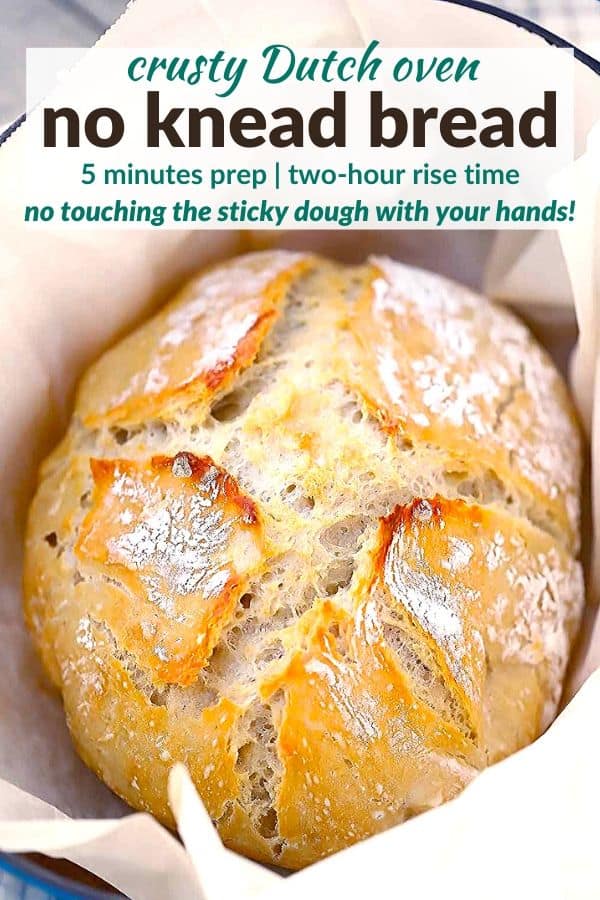
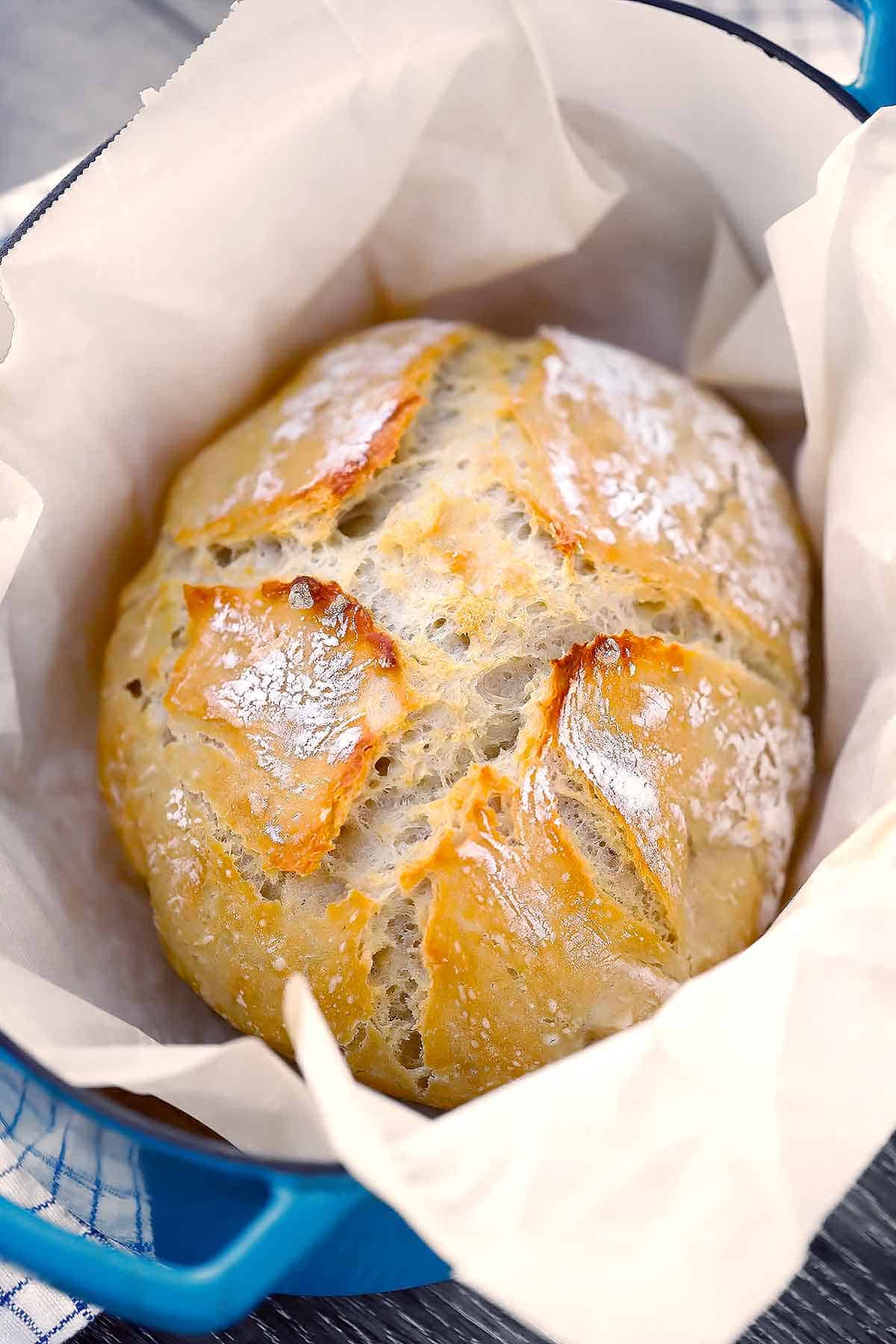
This Dutch Oven No Knead Bread is the perfect way to make a delicious, crusty artisan loaf in the comfort of your own home! Best of all? It takes only FIVE MINUTES of prep, and you don’t have to ever touch the sticky dough with your hands! With a short, two-hour total rise time, you can make this for dinner tonight.
Would you like to email yourself this recipe?
I’m a good cook. I mean, I’m allowed to brag about that… I’ve built a career out of it with this website. But until now, I’ve had the HARDEST time making a good homemade bread.
Am I alone in this? Homemade bread has always eluded me and been a real challenge. My homemade breads have always been too flat, too dry, too hard, too annoying and sticky to work with, etc.
UNTIL NOW.
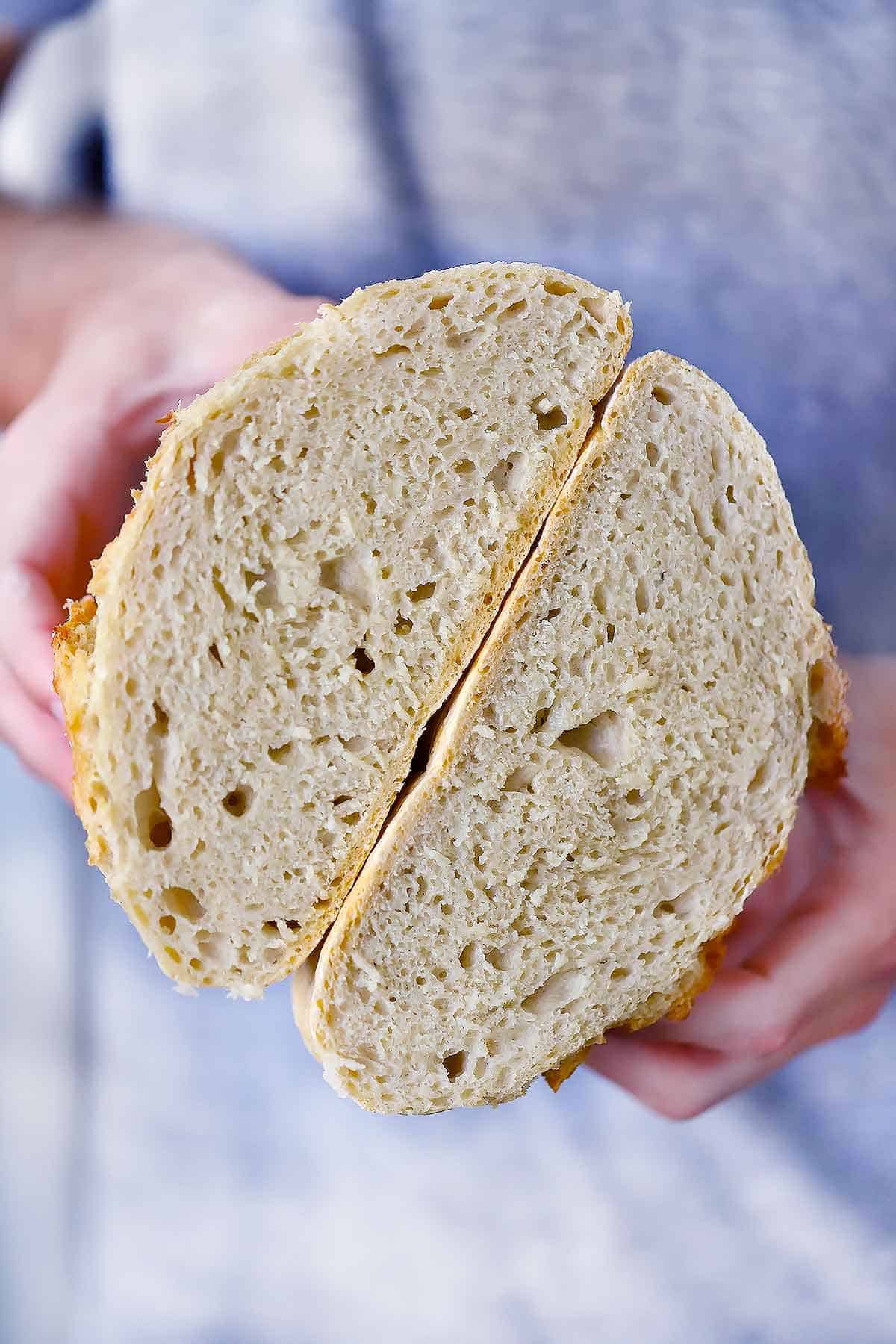
YOU GUYS. I finally cracked the code for homemade bread that isn’t a hassle and is so amazingly delicious, moist, with fluffy holes, and with the perfect crusty crust!
You can use all-purpose flour – no need for fancy bread flour!
This is the only no knead bread recipe you’ll need, and it’s great for beginner bread bakers. The Dutch oven is key for developing a perfect crusty crust and keeping the inside perfectly moist, and best of all, you don’t EVER have to touch the super sticky dough with your hands!
You can let this dough rise for only 2 hours and bake it right away, OR you can keep the dough in your fridge for up to 7 days and use when you want to. Unlike other no-knead bread recipes that require 12 hours minimum rise time.
Here are all the details.
First of all, what is no knead bread?
No knead bread is, as the name suggests, bread that can be made without kneading the dough. No need to knead. Hah!
The dough is notoriously very loose and sticky, which can make it a little frustrating to work with (which is why I developed this method to not touch it at all- it takes a lot of that frustration away!).
No knead bread loafs do not need a second rise time, like a traditional loaf. The bread doesn’t have enough structure to rise “up,” and instead will flatten out and fill the shape of whatever you are making (Note: you CAN do a second rise time with no knead focaccia, which is a flatter bread type.)
The lack of a second rise results in two things: first, a faster overall time to make. And the second: it won’t have as many holes as a kneaded bread dough.
While I love a good fluffy artisan bread with holes for days, I think the pros here outweigh the cons. The bread DOES have some good holes, it’s got a great texture, and the fact that it’s so easy and hassle free is enough to make me never want to make a kneaded artisan loaf again!
How to make no knead dough
You only need water, yeast, flour, and salt for this no knead bread dough.
- First, warm the water (1.5 cups) to about 100 degrees F. A little more or less is fine. I usually measure it in my pyrex measuring cup and put it in the microwave for about 40 seconds, then take the temperature with a meat thermometer to make sure it’s the right temp. Don’t go any hotter than 110 degrees F – it might kill the yeast.
- Then, add the warm water to a large bowl, along with a packet of yeast, or 2.25 teaspoons (instant or active dry is fine) and 1/2 tablespoon of table salt (or 2 teaspoons kosher salt). Whisk together until the yeast and salt are dissolved.
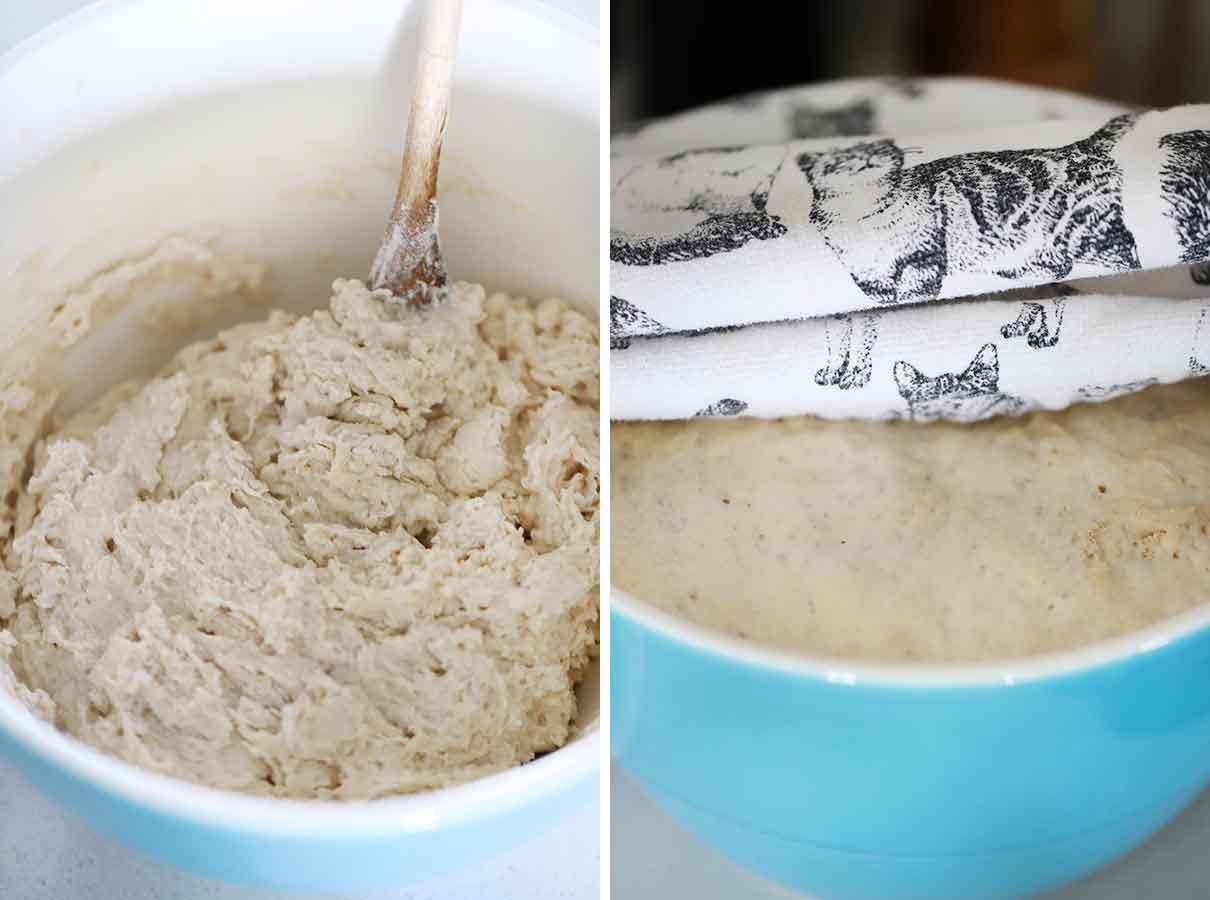
- Finally, add the flour – 3.25 cups – all at once, and stir with a wooden spoon until everything is uniformly wet.
I like to use a silicone spatula to scrape the dough off the wooden spoon, as it will be quite sticky and loose.
Letting the dough rise
Once the dough is mixed, just cover it with a kitchen towel and let it rise in a warm-ish spot for two or three hours. It should double in size at least.
If your house is cold, I recommend turning your oven on for a few seconds, turning it off, and placing the bowl in the warm oven with the door closed to trap the heat in.
If you’re using your oven to cook something (or in the next step when you need to preheat your Dutch oven), you can leave the bowl on top of the stove- the vented heat at the top will help it rise well.
You can also get some really hot water in a mug or glass measuring cup, stick it in the microwave, and place the bowl next to it. Shut the door to the microwave- this will trap the warmth and steam inside.
If your house is warm, you can just leave it out.
If it’s warm outside, you can leave the bowl outside.
Storing the dough in your fridge
After the dough has risen for 2 hours, you can bake it immediately. But if you like, you can stick it in your refrigerator for up to 7 days until you’re ready to bake it!
Cold dough is a little easier to handle, so that’s a pro for this.
I recommend using plastic wrap or something more airtight to cover the bowl when you put it in the fridge. If you know you are making this dough days in advance, you can mix it up in a container, keep the lid on ajar while it’s rising and then seal the lid when you put it in the fridge.
The taste will get funkier as time goes on- by the 7th day, the bread will taste more like sourdough. And the dough will collapse over time- don’t worry about this.
Preheating the Dutch Oven
You want your Dutch oven to be good and hot for baking the bread so it gets a chance to crisp up properly on the outside.
About 30 minutes to an hour before you want to bake the bread, place the Dutch Oven, with the lid on, on the center rack of your oven and turn your oven on to 450 degrees F. Once it reaches 450, keep preheating the Dutch Oven for about 20 minutes.
Be very careful when handling the hot Dutch oven, as it’s very heavy and gets searing hot.
Forming the loaf
Here’s my favorite part! This is how to make the sticky mess of a dough into a loaf without having to touch it with your hands.
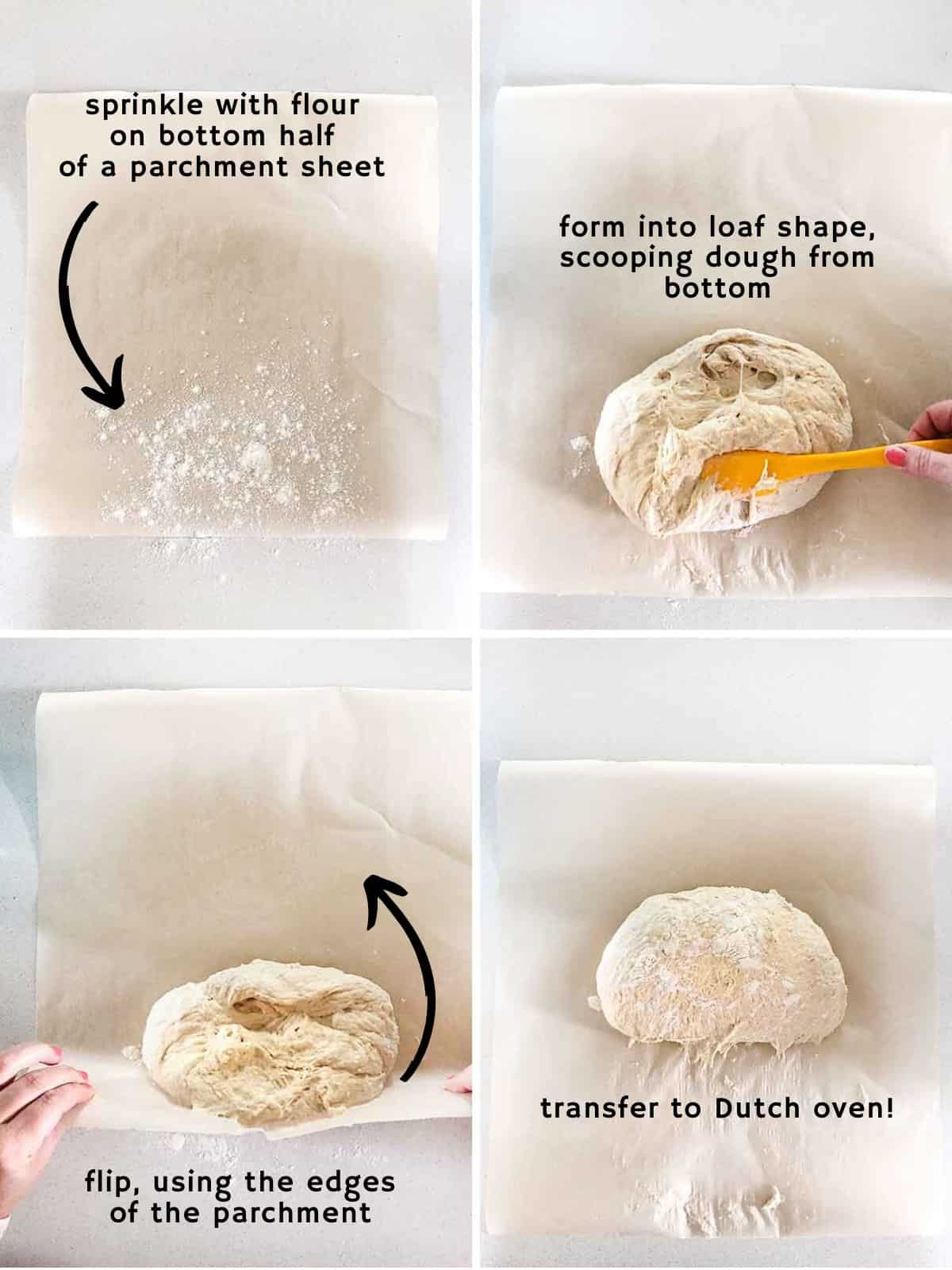
- First, lay a piece of parchment paper on your counter and sprinkle some flour on the bottom part closest to you.
- Then, use a silicone spatula to scrape the dough in a pile onto the floured part. Try to be gentle. The more you handle the dough, the more gasses escape, and the fewer fluffy holes there will be in the loaf.
- Use the silicone spatula to form it into a “loaf” shape, scooping up the dough from the bottom of the pile and placing it on top. You don’t need to do much of this- you just want it to be less of a “pile” and more of a “loaf.” You may also want to make it circular or oval shaped, depending on what shape your Dutch oven is.
- Finally, grab the corners of the parchment paper closest to you and use them to gently flip the loaf onto the center of the sheet of parchment. It may be a little misshapen, which is fine. If it bothers you, you can use the spatula to try to shape it some more but keep in mind, the more you handle it, the less fluffy the loaf will be.
At this point, before putting it in the Dutch oven, you can use a very sharp knife or clean razor blade to make a few cuts about 1/2″ deep in the top of the loaf. I did this with mine in a cross shape from end to end in both directions. This will help it rise up a little more in the oven and get some browner crustier bits. But it’s totally optional.
Baking the bread
Once you have the loaf shape in the center of your parchment, open your oven door and take the lid off the Dutch oven (USING POTHOLDERS of course).
Then, grab the sides of the parchment paper and transfer the loaf to the Dutch oven. Place the cover BACK ON (USING POTHOLDERS FOR THE LOVE OF GOD), and bake at 450 degrees for about 35 minutes.
I know I keep yelling about potholders but too often I’ve reached absentmindedly for the lid of a Dutch oven thinking it’s going to be cool but it’s searing hot. It’s easy to make that mistake!
Once the 35 minutes are up, take the lid OFF, and bake for another 5-10 minutes, until it’s golden brown.
Stop for a moment, and inhale deeply. The smell of fresh-baked bread is one of the best things in the world.
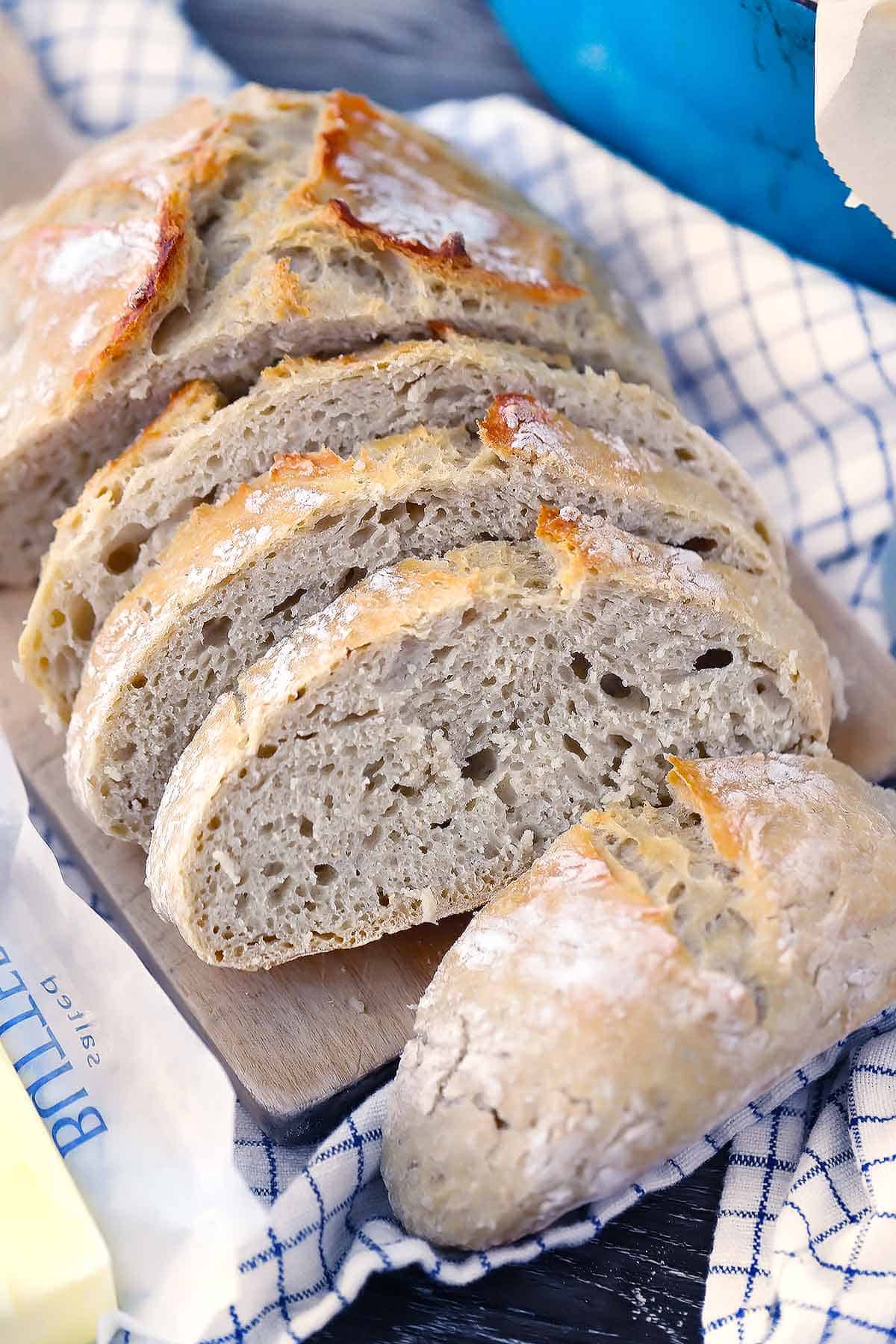
Finally, remove the bread by holding the parchment paper, and place on a wire rack or a cutting board to cool. You want it to cool for at least 10 minutes before slicing.
AND YOU’RE DONE! Congrats on your gorgeous artisan Dutch oven bread!
Why does the lid to the Dutch Oven need to be on while it bakes?
The key to moist bread with a perfectly crusty crust is that it needs to be baked in a humid environment. I know it seams counter-intuitive, but it really works.
The lid to the Dutch oven traps the steam from the sticky dough inside, making it a perfect bread baking environment.
Then, taking the lid off for the last bit of cooking helps really brown the top of the loaf without it over-drying.
It’s truly a miracle to behold. And it’s why we can call it “artisan bread!”
But what if I don’t have a Dutch Oven?
Glad you asked.
This bread is possible to make without a Dutch oven, but you won’t get the same amazingly crusty results. Don’t let that stop you- just temper your expectations a bit.
You can bake the bread, on parchment paper since the dough is so sticky, on a baking sheet or, preferably, in a preheated cast iron skillet.
Here’s what you can do to help make it extra tasty with a crusty crust.
Create a humid environment in your oven by placing a rimmed baking sheet on the bottom rack while the oven preheats. When you add the bread to the oven, pour about 4 cups of water onto the preheated baking sheet. This will create steam as the cold water hits the hot metal. Close the oven door as fast as you can to trap the steam inside.
Can I use another kind of flour?
I used all-purpose for this crusty artisan bread, but you can use bread flour if you like.
You can also use part whole wheat flour– I recommend substituting 1 cup of the AP flour with whole wheat. A 100% whole wheat loaf has not been tested, but it might work. You may also be interested in this multigrain no knead bread loaf.
I haven’t tried using a gluten-free flour mix for this and therefore cannot recommend it. Here’s a gluten-free artisan bread that might be helpful for you!
And finally, you should never substitute a non-flour flour, such as almond flour or chickpea flour, for AP flour. Those won’t work with this bread.
Wait- don’t I need sugar to make bread?
Nope! Some people thing you MUST use sugar in bread or dough recipes so the yeast have something to eat. While yeast do love sugar, and adding sugar to dough can cause a more rapid rise time, it’s not necessary. Yeast love to eat flour too (which is a carbohydrate just like sugar, so acts in a similar way). So you don’t need sugar in this no knead bread recipe at all!
Can I freeze it?
Yes!
The bread stays good at room temperature in a plastic bag or airtight container for about 2 days, and it will get staler as time goes on. Any longer than 1-2 days, and you should freeze it.
You can freeze the loaf whole if you like- you’ll just need to leave it out for about 12 hours before you can slice into it.
Or, you can slice it before freezing, which enables you to take out one slice at a time for toast or sandwiches.
Here are some tips for freezing:
- Store the whole loaf or sliced loaf in an airtight bag, squeezing out as much air as possible. This will help prevent freezer burn.
- Wait until it’s COMPLETELY cool before storing, especially if you’re slicing it before, as the slices may stick together if you don’t.
It should stay good for 2-3 months in the freezer if stored properly.
Why didn’t my dough rise?
If your dough doesn’t rise, it is likely an issue with the yeast itself. Yeast is a living organism and needs to be able to eat food and multiply in order to cause a rise. As they multiply, they release gasses, which causes the airy pockets in the dough. Here are three reasons why your dough may not be rising:
- The yeast is dead to start out with. This can happen if the yeast is old, or sometimes even if you get a dud pack of it. A new pack of yeast from the store can sometimes make all the difference!
- The conditions don’t allow for the yeast to multiply. This usually happens if the temperature is too cold. At cooler temperatures, yeast may multiply much slower, or not at all.
- If the yeast is killed by accident. This can happen if the water temperature is too hot when added to the yeast, which can kill the yeast and subsequently cause no rise. (Note: it is a MYTH that salt kills yeast in this way! If you were to use tons of salt, it may kill the yeast, but the amount of salt used in this recipe won’t kill the yeast – at worst, it may just slow the multiplication process a little bit.
If your dough won’t rise, my advice is to start anew with brand new yeast and make sure to measure the temperature of your water with a thermometer – I love the Thermoworks Thermapen for a super fast, accurate read! Alternatively, you can stick your finger in the water and it should be about body temperature, so if it feels neutral or slightly warm you should be good!
Why did my no knead bread come out dense/flat?
As is often the nature of no-knead bread, it sometimes turns out on the flatter side of things and can often come out a bit dense. This is because gluten doesn’t get developed as much (gluten develops with kneading) so the dough is less “strong” and it tends to deflate and not hold its shape as much.
With practice, it becomes easier to get a taller loaf from shaping the dough without handling it too much and smushing out those air pockets. That gentle handling of the dough while shaping is the most important factor here (and can definitely be tricky – keep practicing!).
Here are some other things that may help!
- Try mixing it together for a longer time initially. Stirring it a lot will help develop some more gluten. A standing mixer makes easy work of this.
- Try using a bread four. Bread flour is higher in gluten and will yield a stronger loaf. It’s also a bit “thirstier” than all purpose flour, so you may need a bit more water in the mix. (On a similar note, different brands of flours often have different gluten contents. I use King Arthur flour, both for all purpose and bread flour. Some people have made this recipe with other brands like pillsbury and had very different results. So do also check your brand!).
- You can try an overnight rise. This recipe is written to have a quick no knead bread within only a few hours. But more often, you see no knead bread recipes with an overnight rise, because time also helps develop gluten (and flavor from a bit of fermentation!). If you do this, use only 1/4 of a teaspoon of yeast, mix the dough, and let it rise overnight. Then, proceed with the recipe as directed.
- It might need more time rising, OR it may have been left rising for too long. It should double in size at least, but it can go a bit longer too. The longer it rises, WITHOUT over-proofing (which is when you let it sit for too long and it deflates because the yeast run out of food!), the more air pockets there will be and the likelihood of getting a taller, fluffier loaf is higher. It can take some practice to know when this sweet spot happens, and it can depend on so many factors like temperature and humidity of the house.
What should I adjust for high altitude with no knead bread?
There are two things to keep in mind when baking no knead bread at a high altitude: the dough may rise faster, and the dough may need more moisture.
I do not live at a high altitude, but many readers have chimed in that they added 1 Tablespoon more water to the mix and had great results. It may also help to ensure the dough stays moist while it rises. You can do this by making sure the towel stays damp during rise time, or using a plastic wrap to trap in the humidity inside the bowl while it rises.
Keep an eye on the dough rising, as well, since it may rise faster at a higher altitude. You can adjust for this by using less yeast, or by giving it a shorter rise time.
Here is a great resource from King Arthur on tips for high-altitude baking!
How to serve an artisan bread loaf
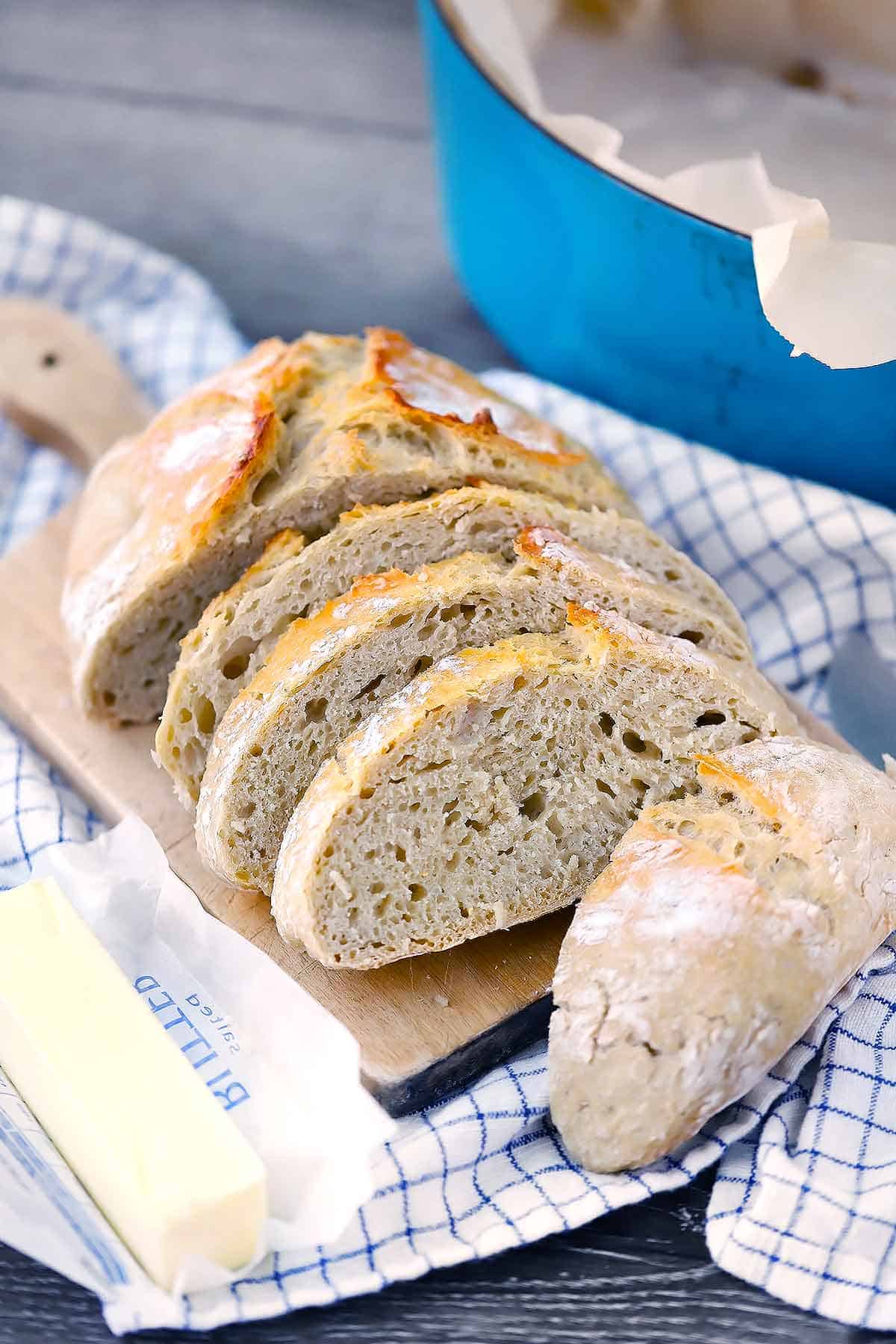
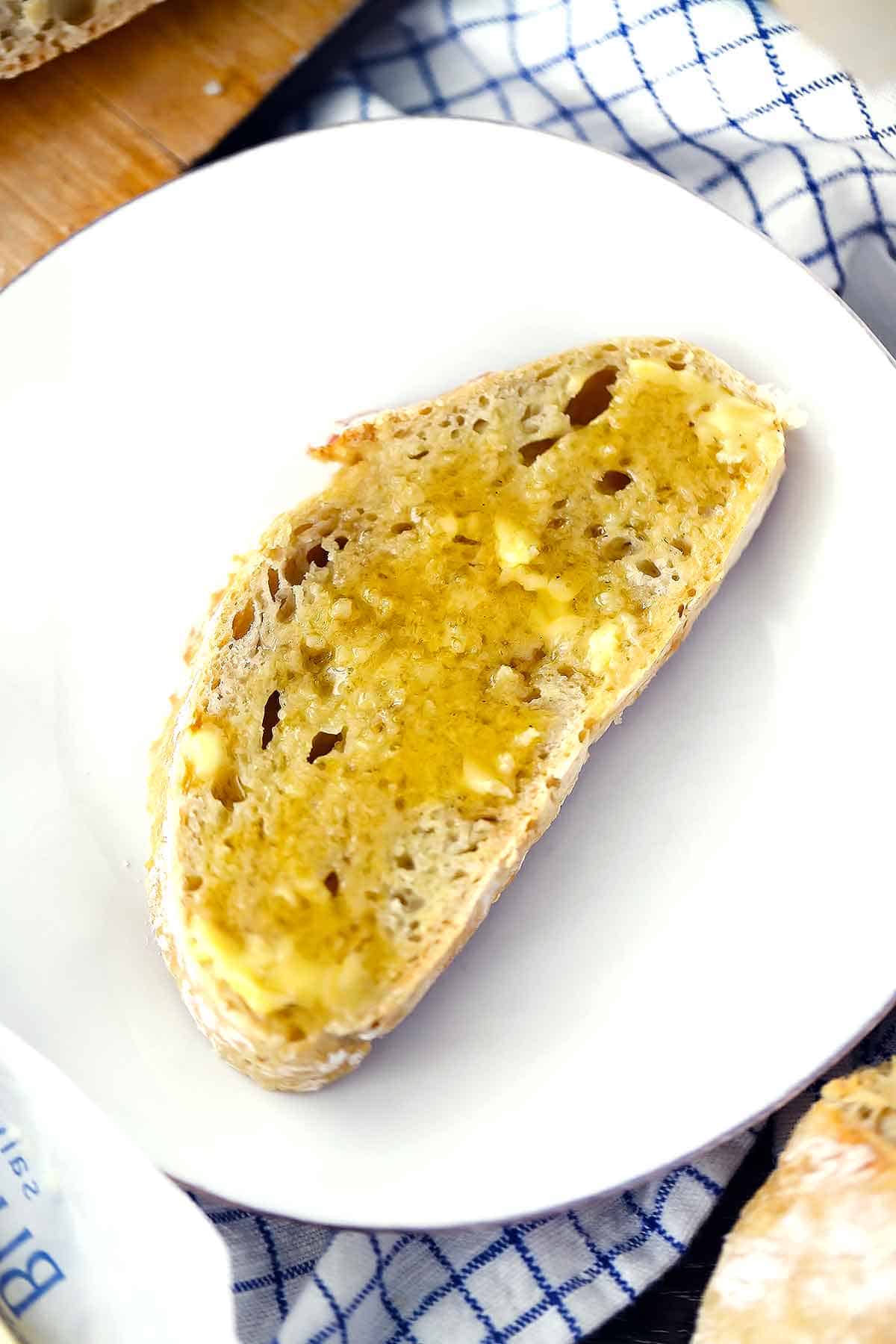
I’m a big fan of eating the bread smeared with salted butter and drizzled with honey, as pictured above. But this homemade bread would be delicious…
- Served with a hearty soup, like split pea soup or lentil soup.
- Used for a fancy grilled cheese, like this leek and gruyere grilled cheese.
- To make cold sandwiches, like this fresh mozzarella, tomato, and basil sandwich with balsamic glaze.
- Served sliced with a basic olive oil and balsamic bread dip, as a side to your favorite Italian pasta recipe (like this five-ingredient pasta with Bolognese sauce).
- Used to sop up the sauce from classic shrimp scampi.
What to make with the stale bread
If you forget about the bread and leave it out at room temperature for more than a couple days, it may go stale. I hardly ever have this happen, as my family and I inhale the entire loaf in one sitting usually. But there are a few things you can do with the leftover stale bread!
Here are my favorites:
- Make homemade croutons with it
- Use it in Panzanella salad
- Make a Tuscan Tomato and Bread soup
Do I HAVE to preheat the Dutch Oven?
No. I’ve made this plenty of times putting the loaf into a cold Dutch Oven and then baking for an extra 5-10 minutes with it covered. Preheating the Dutch Oven before baking the no knead bread can help get it a taller rise while baking, since it will start baking faster and more rapidly. But if you are concerned about preheating your Dutch Oven while it’s empty, as some manufacturers recommend not to do, or if you want it to just be a little easier/safer, feel free to skip this step!
How can I add other ingredients to the dough?
Once of the most common questions I get for this recipe is “Can I add herbs and cheese?” or “Can I add jalapenos and cheddar?” YES! It’s SO easy to add other ingredients to no knead bread.
Just add whatever other ingredients you want when you mix the dough together. Let it rise with all those ingredients, and then shape and bake as directed. You may even want to sprinkle the top with some extra ingredients. For example, sprinkle with grated parmesan or cheddar cheese, or brush with olive oil and sprinkle with rosemary and sea salt.
One thing to keep in mind: if you add ingredients with moisture, such as rehydrated dried fruit, olives, or pickled jalapeños, you will need to drain them very well and/or add less water to the mix. It’s not a huge deal, as this recipe doesn’t require a super exact ratio of liquid to flour, but keep in mind that extra moisture may affect outcome a little bit.
Here are some suggestions for no knead bread flavors:
- Jalapeño and Cheddar – add drained pickled jalapeños and grated or cubed cheddar cheese. Grated cheese will melt into the dough and flavor the whole thing, while cubed will maintain its shape and create melty pockets of cheese.
- Rosemary and Sea Salt – add chopped fresh rosemary to the dough, and before baking brush the top with olive oil and sprinkle with extra rosemary and a sprinkle of sea salt.
- Herb and Parmesan – add a medley of fresh or dried herbs to the dough, as well as grated parmesan. Sprinkle the top with extra herbs and parmesan after brushing with olive oil, if you want.
- Olive – add well-drained olives to the loaf. Whole or chopped, depending on how big you want them in the final thing. This is also great paired with the rosemary and sea salt or herb and parmesan combo above.
- Cinnamon raisin – let some raisins soak in warm water for a few minutes to plump up, drain well, and add them, along with some cinnamon, to the dough. You may want to add a little sugar to the dough as well here – this may cause a faster rise time, since yeast love sugar, so keep that in mind. Here’s a more detailed post on how to make cinnamon raisin no knead bread!
There are so many other ways to play around with other flavor combos- I’d love to hear about them in the comments!
Other easy yeast bread recipes
- Vasilopita (Sweet Greek New Year’s Bread)
- Whole Wheat No-Knead Focaccia with Rosemary and Sea Salt
- Honey Whole Wheat Pizza Dough
- White Sandwich Bread (from The Brown Eyed Baker)
Other no knead bread recipes

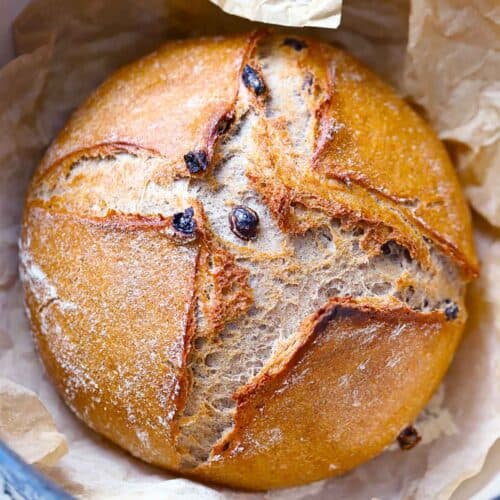


Check out all my homemade basic essential recipes here.
I also LOVE using my Dutch oven to roast a whole chicken.
Did you know commenting and rating recipes is one of the best ways you can support your favorite food bloggers? If you made this Dutch Oven No Knead Artisan Bread, please click the stars below to comment and Rate this Recipe
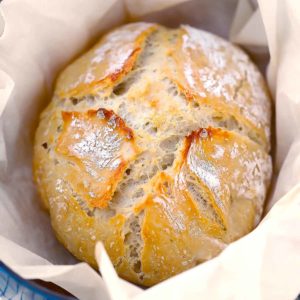
Dutch Oven No Knead Crusty Bread
Equipment
- Silicone Spatula
- Meat Thermometer for taking accurate temperature of the water
Ingredients
- 1 1/2 cups warm water (about 100 degrees F)
- 1 packet yeast (active dry, instant, or quick rise- 2.25 teaspoons)
- 1 ½ teaspoons fine grain salt (preferably NOT iodized, see notes, you can up the amount to 2 teaspoons if you like things really salty!)
- 3 1/4 cups all-purpose flour or bread flour, more if needed to get correct consistency, plus more for dusting (I use King Arthur AP flour – other flours may yield different results)
Want to save this recipe?
Instructions
- In a large bowl (or container), mix together the 1 1/2 cups warm water, 1 packet yeast (or 2.25 teaspoons), and 1 ½ teaspoons fine grain salt, until yeast and salt are fully or almost dissolved (I like using a whisk for this).
- Add the 3 1/4 cups all-purpose flour to the bowl all at once and stir together until a sticky dough forms. Don't worry about mixing it too much, just make sure everything is uniformly wet. It WILL be messy and sticky. You can scrape what's left on the spoon with a silicone spatula. (photo below provided for what the texture should look like – if it seems too wet, add 1-2 tablespoons more flour at a time until it is more like the photo. If it seems too dry, do the same thing with more water).
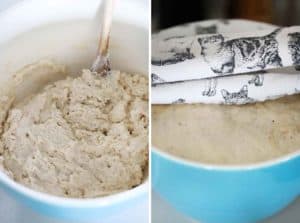
- Cover the bowl with a kitchen towel (or place the container to the lid on ajar). Leave it for 2-3 hours to rise in a somewhat warm place until it's doubled in volume, like photo in previous step (If it's cold out, I like to preheat my oven for a few minutes, then turn it off, then place the bowl in the oven, trapping the heat inside. If your house is warm just leave it out, or if it's warm outside you can place it there).
- After the two-three hour rise time when the dough has about doubled, you have two options: bake, or store in the fridge. See notes for how to store.
- 30 minutes to an hour before you are ready to bake, preheat your oven to 450 degrees F. Place your Dutch oven in the oven, with the lid ON, while the oven is preheating. Once the oven reaches 450, keep it preheating for another 20 minutes, so the Dutch oven gets good and hot.
- Scrape the dough into the edge of a piece of parchment paper dusted with flour. Make it into as much of a "loaf" shape as you can by folding the edges up on top of it (a silicone spatula works well for this).
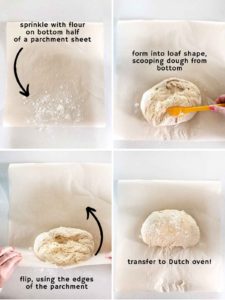
- Then, use the edges of the parchment paper to flip the loaf over so the floured side is on top and the loaf is in the center of the parchment paper. Don't worry about it looking beautiful or smooth on top. My Dutch oven is an oval, so I made an oval shape. You can do a circle if yours is round.
- Optional: use a very sharp knife or clean razor blade to cut a few slits across the top of the loaf about 1/2" deep, across the entire top. I did this in a cross shape for mine.
- Take out the preheated Dutch oven and take off the lid, carefully! Grab the parchment from the sides and place the loaf in your Dutch oven.
- Place the cover back on the Dutch oven and place in the preheated oven on the center rack. Bake for 35 minutes at 450 degrees F (40 minutes if dough was cold from the fridge). Remove the lid and bake for another 5-10 minutes, until a golden brown color forms- longer if necessary. Remove the loaf from the dutch oven (grabbing the sides of the parchment paper works well here) and place it on a wire rack or cutting board to cool for at least 10 minutes (preferably 30 minutes – an hour, if you have time) before slicing.
Notes
- Recent edit to the recipe instructions: I changed the amount of salt from 1/2 tablespoon to 1 1/2 (1.5) teaspoons, which is the exact same amount of salt (there are 3 teaspoons in a tablespoon), but there kept being confusion from readers from misreading tablespoons as teaspoons, resulting in too little salt being used. The recipe is the same, but the ingredient list has been changed from measuring in tablespoons to teaspoons! This is for anyone who has visited this recipe in the past and might be wondering why it says teaspoons instead of tablespoons now; if this is not you, you can ignore this :-)
- Dough too wet/dry: some readers have commented that the dough is too wet. This can happen based on a few variables, including type/brand of flour and accurate measurements. See photo in post and recipe instructions – if texture doesn’t seem similar, add 1-2 more tablespoons flour or water as needed.
- Make two small loaves instead: You can make two smaller by using only half the dough at a time, saving some in the fridge for later. Mix the dough, then divide evenly into two bowls to allow to rise separately. I recommend cutting the cooking time to 20-25 minutes covered if you do this. Alternatively, you can double the recipe to make two large or four small loaves, leaving the extra dough in your fridge for fresh bread every few days! If you want to make one batch of dough to divide, be sure to use a serrated knife to cut the dough into pieces, trying your best not to squish it down as you handle it, and make sure you use a very large container or bowl for this. It’s easier to cut the dough and have it not deflate when it’s cold from the fridge.
- Fine grain salt can be fine sea salt, Himalayan salt, or any other salt you prefer.
- Iodized salt is not recommended, but can be used if that’s all you have. The iodine in the salt may impart a bitter taste in the bread and it also may inhibit the growth of yeast, leading to a longer rise time.
- Kosher salt may be used instead of table salt- I recommend 2 teaspoons since it’s a larger grain. Same goes with coarse sea salt.
- Avoid “gummy” bread by allowing it to cool for a longer time. I often can’t resist and just tear into the thing after 10 minutes, but often the inside seems gummy, and almost raw, because it’s too steamy to cut into. Waiting a whole hour, if you can manage, is ideal.
- Super hard, tough bottom crust? Next time, try putting a baking sheet on the bottom rack of the oven. It will help divert some of that high heat away from the bottom of the Dutch Oven as it bakes.
- Some Dutch Oven manufacturers recommend NOT preheating an enameled cast iron Dutch Oven empty. It may result in the enamel cracking. I’ve never had a problem with my Lodge Dutch Oven, but if you’re nervous about it, you don’t have to preheat the Dutch Oven. Just put the dough in the cold Dutch Oven and bake for 5-10 minutes longer covered, and you should be good to go!
- How to store dough in fridge: If storing in the fridge, leave the lid ajar or use loose plastic wrap or something similar to cover the bowl so gasses can escape. Storing it in the fridge makes the sticky dough a bit easier to handle, and it also enhances the flavor, so I recommend refrigerating it for at least 12 hours. It can stay in the fridge for up to 7 days! After two days, you can seal the lid to the container or cover the bowl tightly with plastic wrap or something else airtight. The taste of the bread will get funkier the longer it stays in your fridge. By the 7th day, it will taste more like sourdough.
- Since cold dough is easier to handle, you can place the dough in the fridge for 30 minutes or so after the two hour rise time, just before baking, so it’s easier to scrape out and form.
- If using cold dough from the fridge, I recommend baking for 5-10 minutes longer with the lid on (40-45 minutes instead of 35 minutes).
- Dutch Oven Alternatives: The Dutch oven does a really good job of trapping the steam, ensuring a crusty, golden brown loaf. If you don’t have a dutch oven, you can bake this bread on a baking sheet or in a cast iron skillet. I recommend adding some water to a rimmed baking sheet, or other oven-safe dish, and placing it in the oven on the lower rack, to add steam to the oven and help develop a crusty crust.
- Freeze the baked bread by slicing it first, then storing it in a zip-top bag, squeezing out as much air as possible. The bread should be completely cool before freezing. You can also freeze a whole or half loaf without slicing, wrapped tightly in plastic wrap or other airtight wrap, but you’ll need to wait to defrost the whole thing before slicing into it.
- Dutch Oven Size: I use my oval 5.5 qt. Dutch Oven or my 6 qt. round Dutch Oven for this recipe. There is some wiggle room, so you can go a little smaller if you like, especially if the parchment paper comes up the sides to prevent sticking. And you can definitely go bigger if you want.
- Parchment paper trick: crumple up the parchment before using it, to help it mold to the shape of the Dutch oven better.
- Sticking to the parchment paper: A few readers have noted that their bread sticks to the parchment after baking. This usually does NOT happen, as parchment paper is non-stick. However, after doing some research, I found that sometimes using a very cheap brand of parchment paper can result in the bread sticking. I recommend using a “nicer” brand of parchment paper, or brushing or spraying it with a little bit of oil or nonstick spray before placing the shaped loaf on the paper and baking it.
- Parchment paper at high temperatures: Some readers have expressed concern over the high temperature used for parchment paper. I’ve used parchment rated to 420 degrees for this recipe with no issue, but you can buy a parchment paper rated to 450 degrees if you are concerned. Here’s a great article about using parchment paper at high temperatures. As a general rule, keep an eye on what you are cooking, for any recipe!
- Avoid too much flour on the outside of the bread: You can use a pastry brush to brush away any thick layers of flour – before baking is best but after works too! You can also spritz the outside of the loaf with some water from a spray bottle, which also can add some lovely blisters to the crust.
- For a hard, too crusty bottom of the loaf: try putting a baking sheet on the bottom rack of the oven while baking. It helps deflect some of that direct intense heat away from the bottom of the Dutch Oven, resulting in a softer bottom to the loaf.
- Dry dough? Some readers have commented that their dough is dry, not wet and sticky. If this happens, it may have something to do with the brand or type of flour, or measuring discrepancies. Jut add a little more water until it’s a little looser and you should be good to go!
- High Altitude? A reader did this at a high altitude and she said she just added a little more water to the dough (about 1 tablespoon) and kept the towel damp during the rise time.
- Adding other ingredients: Feel free to mix in other ingredients, like herbs, roasted garlic, parmesan cheese, etc. with the rest of the ingredients! Then let it rise, shape, and bake according to instructions. See more about this in the body of the post with flavor suggestions.
- Dough not rising? This is likely a yeast issue. Yeast is a living organism. Sometimes, if using an old batch of yeast, or just a dud batch, the yeast is not alive anymore and won’t work. Also, if using too hot water, the yeast may die and cause the dough to not rise. If you are unsure if your yeast is good, there are two things you can do. 1) You can go buy a fresh batch! or 2) You can test it. Just add 2.25 teaspoons (1 packet) of yeast to 1.5 cups warm (100-110 degrees F) water, as directed in the recipe. Don’t add the salt yet; instead, add 1/2 – 1 teaspoon of sugar or honey. Stir until the yeast is dissolved and leave for 5-10 minutes. If the mixture turns foamy and has a bready aroma, your yeast is good, and you can continue with the recipe by adding the salt and flour. If it does not, your yeast is not good anymore, and you should go buy another fresh batch.
- Recipe inspired by the no knead bread process made famous by Jim Lahey. It’s important to note that while Lahey made the recipe popular, no knead bread existed long before as a result of mostly domestic home labor by women. Here’s an interesting article about the history of no knead bread origins!
Nutrition
Nutrition Information Disclaimer
The provided nutrition information is my best estimate and reflects one serving of the recipe (total servings indicated at top of recipe card). It does not include any added sodium from seasoning to taste, any optional ingredients, and it does not take brands into account. I use an automatic API to calculate this information. Feel free to calculate it yourself using one of these tools:
Erin
I found this recipe randomly and used it to make my first ever loaf of bread – and it turned out PERFECTLY. My mom, who has been cooking and baking for 40 years, said she always wanted to be able to make a loaf of bread that was this pretty. She didn’t believe me when I told her how easy it was. This is now her go-to recipe, too. You have tons of fans in my family!
Elizabeth Lindemann
So glad you liked it! What a lovely comment to get this morning – it made my day!
Diana
I love this recipe! I was looking for a good bread recipe for my cloche and this one works great! Turns out amazing every time !!
I wanted to try a whole wheat bread and I was curious if you had any suggestions for how to make it work with this recipe!
Elizabeth Lindemann
So glad you liked it! I personally like substituting about 1 cup of the all purpose flour for whole wheat – I find it’s easy to be successful with doing a partial whole grain loaf. Whole wheat flour has less gluten and is heavier and denser, so the dough won’t rise as much by nature. And if you do 100% whole wheat it can be difficult to get any significant height to the loaf. Whole wheat flour is also “thirstier” than all purpose, so you may need more water. So just be prepared for it to act a lot differently, but experimenting with it is so fun!
Tammy
I haven’t tried it with this recipe, but I often add a little to my dough recipe when I make my sourdough recipe. I think the key is to only add a small amount, especially at first. Whole wheat absorbs a lot more water. I often add 50 g of whole wheat and 50 g of rye to my 400 g of bread flour when I make sourdough. So, you can see, it’s only a small percentage of the dough. But even that small amount gives it a lot of flavor!!
Elizabeth Lindemann
Thanks for sharing this!
Savannah Neeley
So easy and SO DELICIOUS!
Elizabeth Lindemann
So glad you liked it!
Lizza Streicher
I’m so grateful to have found this! I didn’t realize I can make bread! I have never baked anything in my life! Thank you for making it easy enough for someone like ME!
Elizabeth Lindemann
So glad you liked it!
Lindsay
This recipe made me feel like a full-on functioning, capable, grown-up! (I’m 41😅) recipe was effortless and really made me feel like I accomplished something. I didn’t have a dutch oven so I just used a completely metal Soup pot with a lid that I’ve had for years and everything came out perfect, my mother sent me this recipe because she makes it weekly. Can’t wait to start mixing fun ingredients in, thank you so much for this recipe!
Elizabeth Lindemann
So glad you liked it!
Susan
Excellent recipe and directions! I am not a baker and was very nervous but it was easy thanks to your tips and thorough instructions.. The first recipe I tried was similar but not the same and ended up in the trash. My first attempt with your recipe came out perfect! Second time I was braver and added a little dried thyme and rosemary and a little olive oil – soooo good!
Elizabeth Lindemann
So glad you liked it!
Nancy
Made this for the first time tonight and it was so easy and delicious! My husband said this is the type of bread he wants when he goes to a restaurant. The bottom of mine was a little tough, so I am going to try the sheet pan trick you recommended.
Elizabeth Lindemann
So glad you liked it!
Lisa Dee
My first artisan bread, and it rocked! Thanks!!
Elizabeth Lindemann
So glad you liked it!
Stefania
Not sure why but the dough was sticky but not wet. I had to knead it a bit in the bowl to get all the flour into it. I followed the re ice exactly. Hopefully it will turn out. It is now proofing.
Elizabeth Lindemann
Hope it turned out well for you! It shouldn’t be soupy-wet (though some people have said that has happened to them, sometimes it depends on the flour used). Sticky is the right texture. You can always adjust and add a tablespoon or two of more water (or flour, if it’s the opposite problem), and it will get easier to adjust on the fly like this with more practice. Hope that helps!
nitghtbreadmaker
You should have cooled that bread a minimum of 3 hours, but preferably overnight and it wouldn’t look so gummy.
Elizabeth Lindemann
Feel free to cool longer if you want 😉
Stephanie Murray
Made this last night, the whole loaf was gone. So delicious, I’ve made a handful of different bread recipes and this is by far the best. Thank you!
Elizabeth Lindemann
So glad you liked it!
kk
Love this recipe, just trying to perfect it. Your directions are detailed. I’m just can’t get this perfect. I weighed my flour this time, dough doubled, when I scrapped my dough out on parchment paper, it was like it was too wet, but when I originally mixed it, it seemed good without adding any more flour. I know bread can be finicky, I’m just want to make bread lol. You wouldn’t have a video of this would you? That would be so helpful!
Elizabeth Lindemann
So glad you liked it! If it helps – every time I make this, it comes out a bit different than the time before, haha! I’m glad you asked about the video- I’ve been wanting to do one for a while and I’m going to move it up on the priority list. I’ll let you know when it’s done, I think you’re right it would be super helpful to see the texture here. Thanks!
Katie
OMG, I have just tasted the loaf made today with your recipe , it is delicious & the best I’ve ever made !
At long last I have found a recipe that is 100% successful.
For a year I have been trying to bake bread without my machine, always the loaves have been heavy, hard & like doorstops, but today, for the first time , the dough rose really well , I put this down to putting the yeast in warm water ?
I didn’t do any kneading & only left the dough to rise for 2 hours when it quickly doubled in size.
Thank-you Elizabeth I’m so thrilled at this success . :-)
Tonight we have a consistency of a fresh baguette & so much flavour….I did use bread flour 55, which I’ve done before but never has a loaf turned out like this one.
Your recipe & method is now downloaded & will be used from now on.
Elizabeth Lindemann
So glad you liked it! What a lovely comment, thank you so much!!
Katie millington
Hello again Elizabeth, for further info, I have now made a second loaf using all the same weights & method but with a heavier 7 cereal flour mix, 2 hour rise & dried yeast.
Results are just as perfect…..happy days !
Elizabeth Lindemann
This is great – so glad to hear it turned out well with these ingredients! Thanks for sharing!
Moira L.
My goodness.. this couldn’t have been simpler! I shy away from baking, but this bread could easily be a daily occurrence in my house. Actual hands-on time between making the dough and baking it is close to nothing! Turned out crusty and craggy.. perfection.
Elizabeth Lindemann
So glad you liked it!
Yarka Johnson
This was an awesome recipe, thank you. At what point can I add garlic/cheese/seeds?
Elizabeth Lindemann
So glad you liked it! Just add anything in when you mix it all up in the beginning!
Kae
Would a 3 1/2 qt DO be too small?
Elizabeth Lindemann
I think it would work!
Suzanne
I’ve made this bread several times and we Love it…. What if I’m out of parchment paper ??? Can I use foil or just put directly in Dutch oven ?
Elizabeth Lindemann
So glad you liked it! Some people have had success with just brushing the pot with oil and/or sprinkling with cornmeal. I personally wouldn’t use foil as I feel like it would stick – if you do use it, I recommend brushing liberally with oil. Hope that helps!
Toni B
I make this bread every weekend because its so easy. It fit well into a busy schedule and it ALWAYS turns out well.
I’d love to hear how others have fared with substituting whole wheat for one cup of the white flour.
Elizabeth Lindemann
So glad you liked it! I substitute 1 cup of the flour for whole wheat all the time with great results. I do add a couple tablespoons more water in this case. It doesn’t rise as tall but that’s kind of the nature of whole grain flours. Hope that helps!
Momma D
My beautiful sister-in-law shared this recipe as she makes it and says it’s delicious! I made two batches of dough-and they didn’t rise, even after carefully measuring water temp.
She asked me if I put the yeast and water together and the salt in with the flour? “No, that’s not what the directions said.” The salt will kill the yeast!”
I am NOT giving up! Third time will be successful, I hope!
Elizabeth Lindemann
It’s actually not true that salt will kill the yeast – that’s something that’s commonly thought of but in this recipe, it does work! I’ve done it plenty of times as written and always mix my salt into the dough in the beginning. Salt *can* slow down the growth of yeast but kills it only in large quantities – much larger than would ever be in a bread recipe like this. That said, the recipe will still work if you mix the water yeast and flour together, let it sit for 10 minutes or so, then mix the salt in. It’s more likely a yeast problem – try a fresh batch and see what happens! Good luck!
Brenda
My first attempt at making this bread for out Thanksgiving supper and it turned out fabulous. I added some spices and cheddar cheese before I places in the Dutch oven. YUMMY
Elizabeth Lindemann
So glad you liked it!
Kevin Baillie
Made this today exactly as the recipe stated and it turned out great. Simple recipe and very easy cleanup. Great taste and nice and crusty. May add some spices or herbs next time, but it is really good as is.
Elizabeth Lindemann
So glad you liked it!
Kathleen French
My niece does this and its wonderful. Since I taught her a lot of what she knows, I decided to try this. I am concerned that it has no oil. My grandmother was the best bread baker across three states. She always slathered either melted butter, olive oil, or bacon grease to the outside of the bread. I did evoo with this recipe and it was fine for the top, but most of the oil slid down to the bottom of the pot and I felt it made the bottom of the loaf too crispy almost hard. Your thoughts?
Elizabeth Lindemann
No oil necessary, though you can definitely add it if you want! The steam that’s trapped in the pot is what makes the crust crusty here without the need for any oil. It makes sense that in a hot bot the bottom got hard and crispy, it likely fried in the oil at that hot temperature. See the recipe note about using a sheet pan on the bottom rack to help avoid a super hard bottom crust, and give it a try with no oil! I’m excited to hear how it turns out for you!